Why We Chose It
The Bonham Conclusion
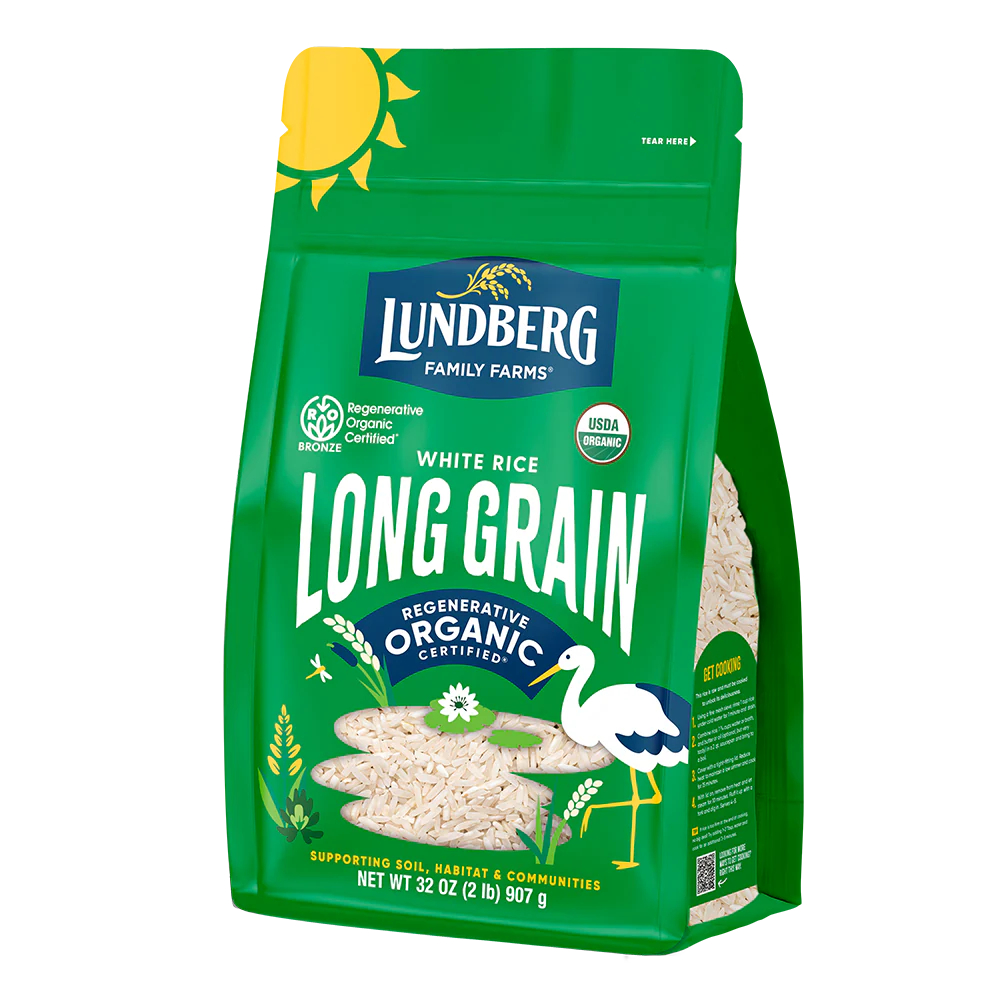
We chose Lundberg Family Farms Organic Long Grain White Rice because it is among the cleanest long grain white rice options identified by independent third-party testing, backed by over a decade of published heavy metals data, and produced under the most rigorous regenerative organic farming certification available.
Mamavation sent 57 rice products to an EPA-certified laboratory testing for total arsenic, lead, cadmium, and mercury. Lundberg Long Grain White Rice tested at approximately 65 ppb total arsenic with non-detectable lead — placing it among the best-performing long grain white rice products in the entire study. Arsenic is present. We will not pretend otherwise. But the question with rice is never whether arsenic exists — it is how low, how transparent the brand is, and whether the sourcing minimizes the risk. On all three counts, Lundberg is the best we found.
Who They Are
Lundberg Family Farms — What Makes Them Different
Lundberg Family Farms has been growing rice in California's Sacramento Valley since 1937 — nearly 90 years of continuous family farming on the same land. California is the most important factor in their arsenic profile. Rice grown in California consistently tests lower for arsenic than rice grown in the southern United States — particularly Arkansas, Louisiana, and Texas — because California soils have not been historically treated with arsenic-based pesticides the way southern cotton-farming soils have been.
Lundberg holds Regenerative Organic Certification — the highest farming standard available, requiring USDA Organic as a baseline and adding soil health requirements, animal welfare standards, and farmer fairness criteria. They explicitly prohibit glyphosate and all synthetic toxic pesticides under this standard.
They use food-grade CO2 rather than chemical fumigants to keep stored rice fresh — a meaningful and uncommon distinction from virtually every other rice brand. Most conventional rice is fumigated with chemical agents during storage. Lundberg does not do this.
On transparency: Lundberg has published third-party heavy metals testing results since 2013 — over a decade of publicly available data at lundberg.com/pages/heavy-metals-in-food. Testing is conducted by AGQ Labs, an accredited independent laboratory. Their 11-year average inorganic arsenic across all varieties is 0.09 ppm — well below FDA, EFSA, and CODEX maximum levels.
Claims & Certifications
What Lundberg Claims — And What Each One Means
Independent Research & Lab Testing
What Outside Investigators Found
Mamavation Long Grain Rice Investigation: Mamavation sent long grain rice products to an EPA-certified laboratory testing for total arsenic, lead, cadmium, and mercury. Lundberg Organic Long Grain White Rice tested at approximately 65 ppb total arsenic with non-detectable lead — placing it among the best results in the entire long grain white rice category. Their full investigation with raw data is available at mamavation.com — Long Grain Rice Arsenic Investigation.
Lundberg's own published testing: Over a decade of AGQ Labs results published at lundberg.com/pages/heavy-metals-in-food. Their 11-year average inorganic arsenic of 0.09 ppm is well below the FDA maximum level of 0.1 ppm for infant rice cereal and well below EFSA and CODEX standards for white rice at 200 ppb inorganic arsenic.
NutritionFacts.org analysis: Dr. Michael Greger's team noted that Lundberg consistently outperforms the national average for arsenic in rice, with their aromatic varieties averaging below national white rice levels — a consistent pattern across years of published data. Analysis available at nutritionfacts.org — Which Rice Brands Have the Least Arsenic.
Important note on Lundberg Basmati: Lead Safe Mama independently tested Lundberg Organic California White Basmati Rice in October 2024 and found concerning arsenic and cadmium levels. We want to be clear — that is a different product from the Long Grain White Rice we carry. The two varieties perform differently in independent testing. We carry the Long Grain White specifically because of its testing profile. The full Basmati report is at tamararubin.com — Lundberg Basmati Test.
We review published lab results and independent investigator findings. We are not a laboratory and do not conduct our own testing. All primary sources are linked above for your own review.
The Broader Picture
Why Arsenic in Rice Is a Category-Wide Problem — Not a Lundberg Problem
Arsenic in rice is not a brand failure. It is a geological and agricultural reality that affects every rice crop on earth. Rice absorbs arsenic from soil and water more efficiently than virtually any other food crop because of how it is grown — submerged in flooded paddies, creating anaerobic conditions that convert soil arsenic into a soluble form that the rice plant absorbs readily through its roots.
The primary driver of elevated arsenic in American rice — particularly southern US varieties — is historical agricultural contamination. Cotton fields across Arkansas, Louisiana, Texas, and Mississippi were treated for decades with arsenic-based pesticides, primarily lead arsenate and calcium arsenate, before those chemicals were banned. When rice farming replaced cotton farming on those same fields, the crops absorbed arsenic from decades of accumulated soil contamination. California rice fields do not have this history, which is why California-grown rice consistently tests lower.
Mamavation confirmed that 98% of all rice products they tested contained detectable total arsenic. Consumer Reports has conducted multiple investigations over the years reaching the same conclusion. The question is never whether rice contains arsenic — it does — but how much, where it was grown, and how transparent the brand is about what they know.
Two practical steps reduce arsenic in any rice regardless of brand: rinsing rice thoroughly before cooking removes surface starch and some surface contamination; cooking rice in a higher ratio of water — six parts water to one part rice, then draining the excess — has been shown to reduce arsenic content by up to 40% compared to the standard absorption method. These are meaningful steps worth taking regardless of which rice you choose.
"98% of rice products tested by Mamavation contained detectable total arsenic. The question is never whether arsenic is present — it is how low, how transparent the brand is, and whether the sourcing minimizes the risk. On all three counts, Lundberg is the best we found."